The problem
AWS spend is invisible until the monthly bill arrives, and checking it means giving people console billing access most of the team shouldn't have.
What it does
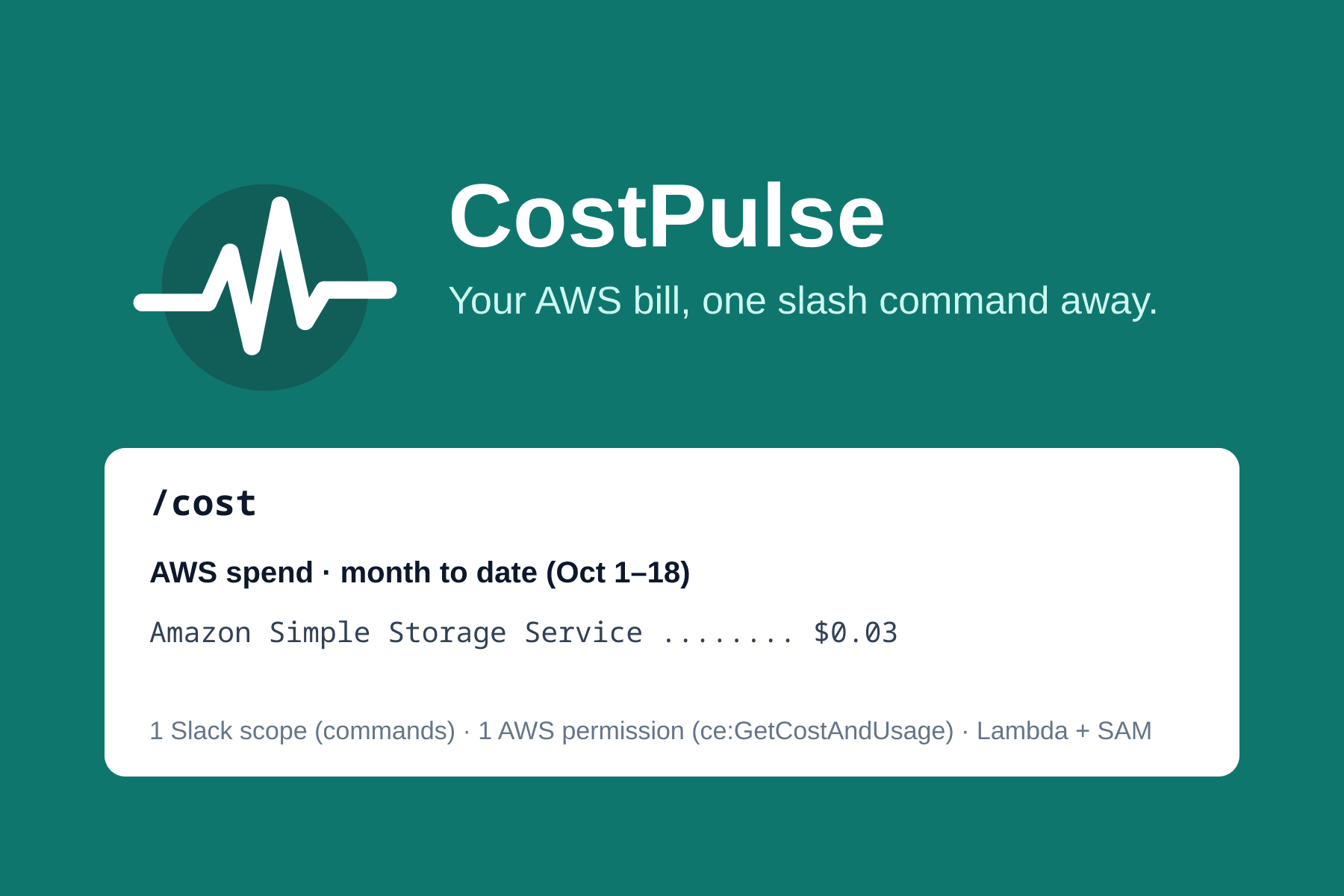
Type /cost in an allowed Slack channel and CostPulse replies with spend by service:
/costor/cost month: month to date (on the 1st, the full previous month)/cost today: today so far, in UTC/cost week: the last 7 days
The reply lists the top 5 services plus an "Other" row, and the total always equals the sum of the displayed rows.
Architecture
- One Lambda behind a Function URL, deployed with AWS SAM to
us-east-1. - Bolt lazy listeners acknowledge Slack inside its 3-second limit, then the function re-invokes itself asynchronously to query Cost Explorer and post the in-channel reply through
response_url. - Secrets (signing secret, bot token) live in SSM Parameter Store as
SecureString, read once per cold start. - In-memory cache per date range for one hour, so repeated commands don't pay for repeated Cost Explorer calls.
Least privilege, on both sides
- Slack: exactly one bot scope,
commands. Replies go back throughresponse_url, so the app needs no permission to post, read messages or see users. - AWS: an explicit IAM role with five actions:
ce:GetCostAndUsage,ssm:GetParameteron two parameters, a self-invoke for the lazy listener, and writes to its own log group. Tests fail if the policy ever widens. - Channel allowlist: commands from any other channel get a private hint, and an empty allowlist rejects everything.
Cost guardrails
A public Function URL has no rate limiting, and Lambda bills even rejected requests. So the stack adds a $5 monthly account budget with email alerts, a CloudWatch alarm on more than 1,000 invocations in 5 minutes, and a documented kill switch (reserved concurrency 0) that was tested live.
Results
- 55 tests, including signed-request tests that drive Bolt's real Lambda adapter and replay the self-invocation.
- Warm acknowledgements in about 120 ms; a cold start of about 3 seconds on the server, which is the next thing to tune.