Every Kubernetes deployment seems to end the same way.
kubectl apply -f deployment.yaml
The pipeline finishes. Everyone moves on.
But what happens if someone manually changes the cluster five minutes later?
Nothing. Your CI pipeline already finished.
That's the problem. GitOps solves it.
I recently tested ArgoCD in a live Kubernetes cluster, intentionally created configuration drift, and watched ArgoCD fix it automatically within seconds.
Here's what I learned.
The Problem with kubectl apply
Traditional CI/CD looks like this.
Developer
     │
     ▼
CI Pipeline
(Build → Test → Push Image)
     │
     ▼
kubectl apply
     │
     ▼
Kubernetes Cluster
The deployment ends after kubectl apply. After that:
- Nobody checks whether the cluster still matches Git.
- Manual production fixes remain forever.
- CI needs cluster-admin credentials.
- Git is no longer the source of truth.
This creates configuration drift.
What GitOps Changes
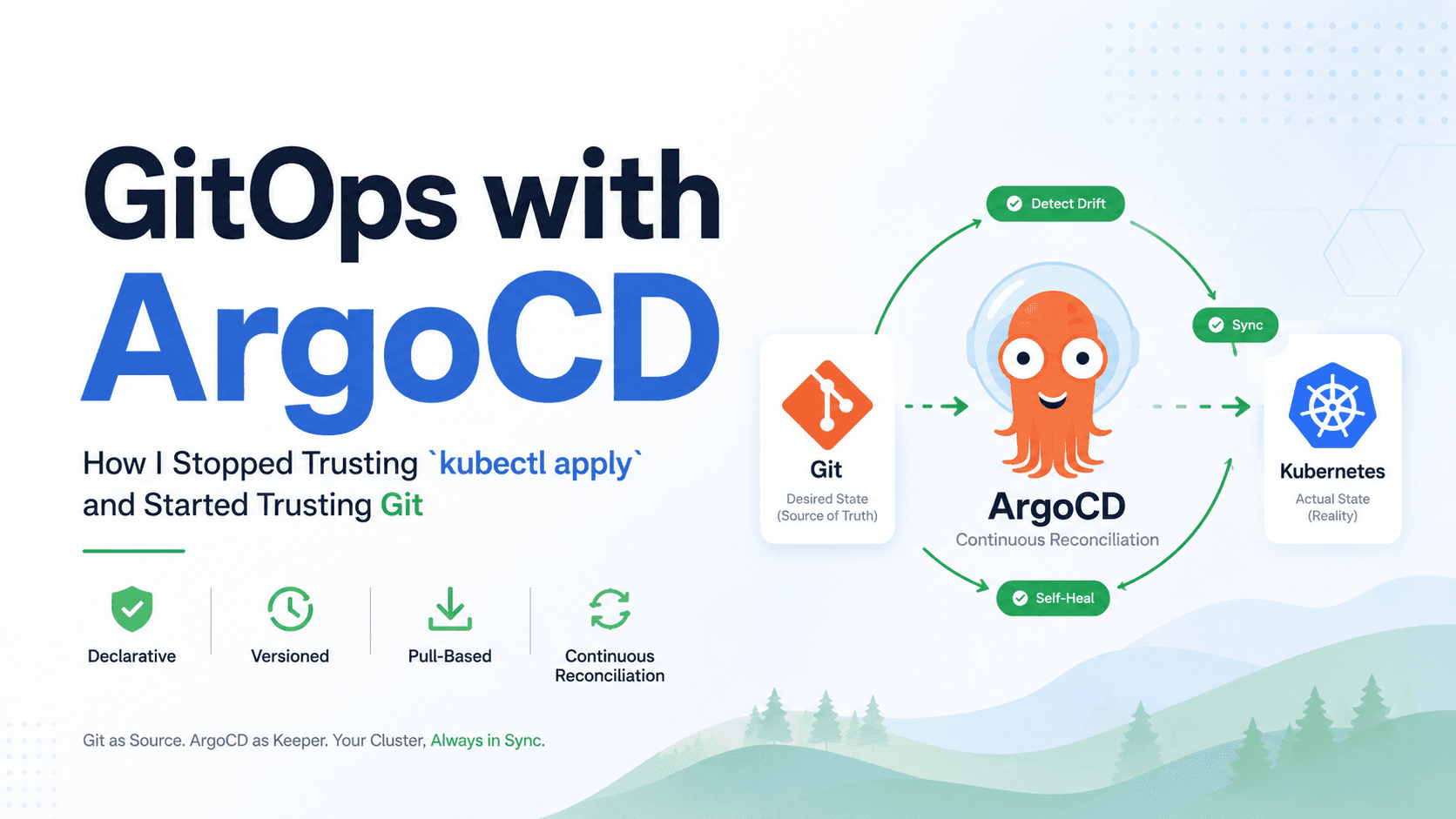
GitOps flips the deployment model. Instead of CI pushing changes, the cluster pulls them. Git becomes the only source of truth.
Four core principles:
- Declarative: describe the desired state instead of deployment steps.
- Versioned: every infrastructure change is a Git commit.
- Pull-based: the cluster pulls changes from Git. No external system pushes into production.
- Continuous reconciliation: the cluster constantly compares reality with Git. If something changes manually, it changes it back.
How ArgoCD Works
ArgoCD runs inside Kubernetes. Its job is simple:
Git Repository
        │
        ▼
     ArgoCD
        │
Compare Desired State
        │
        ▼
Kubernetes Cluster
Every reconciliation loop:
- Reads manifests from Git
- Reads live Kubernetes objects
- Compares both
- Applies changes if they don't match
Deployment is no longer a one-time event. It's an ongoing process.
The Components
ArgoCD consists of four major pieces:
- API Server: handles UI, CLI and API requests.
- Repo Server: clones Git repositories and renders manifests.
- Application Controller: the reconciliation engine. This is where the magic happens.
- Redis: caches manifests and application state.
Repository Structure
One mistake many teams make: keeping application code and Kubernetes manifests in the same repository.
A better approach:
Application Repo
│
├── Source Code
├── Tests
└── Dockerfile

Manifest Repo
│
├── base/
└── overlays/
    ├── dev
    ├── staging
    └── prod
Benefits:
- Independent infrastructure changes
- Cleaner CI pipelines
- Better access control
- Easier environment management
My Test
I deployed the Guestbook application with ArgoCD. Git declared:
replicas: 1
Everything was healthy. Then I intentionally changed production.
kubectl scale deployment guestbook-ui \
  --replicas=5
Git still wanted 1 replica. The cluster now had 5.
What Happened Next
Within seconds, ArgoCD detected the drift. It automatically terminated the four extra pods.
No engineer intervened. No pipeline reran. Git simply won, exactly as designed.
That single demo changed how I think about deployments.
Is ArgoCD a CI/CD Replacement?
No. CI and GitOps solve different problems.
| CI | ArgoCD |
|---|---|
| Build | Deploy |
| Test | Monitor drift |
| Security scanning | Self-heal |
| Push images | Continuous reconciliation |
Think of ArgoCD as the deployment engine, not the build system.
Key Takeaways
- Git should be the single source of truth.
- Stop pushing changes into production.
- Let the cluster pull them instead.
- Continuous reconciliation is the real power of GitOps.
- Self-healing removes configuration drift before it becomes an incident.
Final Thoughts
The biggest mindset shift wasn't learning another Kubernetes tool. It was realizing that deployment shouldn't be a one-time command.
It should be a continuous loop that constantly ensures production matches Git.
Once you watch ArgoCD automatically undo manual changes in real time, it's hard to go back to ending every pipeline with kubectl apply.